Land Certificate

Militia/Soldiers

Ground Breaking

Chronological Narratives

Memberships/Donations (PDF)

Home

This chronological narrative was compiled
by Mr. Clyde Bunch,
of Jessamine County, Kentucky,
and provided to the Logan's Fort Foundation,
which accepts full responsibility for authenticity.


February, 1775 - Felix Walker's Narrative. "In the month of February in the year 1775, Captain William Twetty, Samuel Coburn, James Bridges, Thomas Johnson, John Hart, William Hicks, James Peeke, and myself, set out from Rutherford County, North Carolina, to explore a country by the name of Leowvisay, greatly renowned and highly spoken of as the best quality of land, abounding in game, now the State of Kentucky."

March 10, 1775 - Felix Walker's Narrative. " About the 10th of March we put off from the Long Island, marked out our track with our hatchets, crossed Clinch and Powell's river, over Cumberland mountain, and crossed Cumberland river - came to a watercourse called by Col. -------- Rockcastle river; killed a fine bear on the way, camped all night and had an excellent supper."

March 10, 1775 - Long Island on the Holston. Daniel Boone with a party of 21 men, join with Capt. Twetty's party of 8 and start for Kentucky.
Note: Long Island was on the present site of Kingsport Tenn.

March 11, 1775 - Harrodsburg, reoccupied.

March 17, 1775 - Henderson and others sign deed with the Cherokee at Watauga.

March 20, 1775 - Henderson's Journal " Monday March 20th 1775, Having finished my treaty with the Indains at Wataugah set out for Louisa."
Note: This treaty was held at Sycamore Shoals on the banks of the Wataugah River near the present town of Elizabethon, Tennesse, about 15 miles southeast of Long Island.

March 25, 1775 - Felix Walker's Narrative. " On the 25th of March 1775, we were fired on by the Indians, in our camp asleep, about an hour befor day. Capt. Twetty was shot in both knees, and died the third day after. A black man, his body servant, killed dead; myself badly wounded; our company dispered."

April 1, 1775 - Boone's letter to Col. Henderson. [extracts] "On March the 25 a party of Indians fired on my Company about half an hour before day and killed Mr. Twetty and his negro and wounded Mr. Walker very deeply, but I hope he will recover. On March the 28 as we were hunting for provisions we found Samuel Tate's son, who gave us an account that the Indians fired on their camp on the 27 day. My brother and I went down and found two men killed and sculped, Thomas McDowell and Jeremiah McPeters."

April 1, 1775 - Daniel Boone and party arrive a the site of Boonesborough.

April 7, 1775 - Henderson's Journal "received a letter from Daniel Boone that his company was fired upon by Indains who killed two of his men."

April 8, 1775 - Henderson and party meets 40 men about 4 miles from Cumberland Gap. They are fleeing Kentucky in fear of Indians.

April 15, 1775 - John Floyd, letter to William Preston. Holston Settlement, Floyd says; "Henderson left Powell's Valley on the 8th, to join Boone in Kentucky."

April 15, 1775 - Henderson's Journal - "Travel'd about 18 miles and camped on the North side of Rock Castle River - this river a fork of Cumberland. Lost an ax this morning at camp."

April 16, 1775 - Henderson's Journal - "About 12 oclock met James McAfee with 18 other persons returning from Cantuckey. Travel'd about 22 miles and camped on the head of Dicks River where Luna from McAfees camp came to us resolved to go to the Louisa."

April 20, 1775 - Richard Henderson and party arrives at Boonesborough.

April 21, 1775 - John Floyd letter to Col. William Preston. [extract] "I have now an opportunity, by Jas. McAfee to inform you that I am as far on my way to Kentucky as Powell's Valley and 12 miles of Cumberland Gap, and shall proceed on my way tomorr. Major [David] Roberson and his company are here, and have waited for my coming. Mr. [Joseph] Drake, Mr.[Thomas] Madision, and their companies, are lower down the valley 20 miles, making improvements. They told the major, when I came, to send for them, and that they would go on with us. They had all been almost out to Kentucky, but on hearing of the murder, they this far, to wait for me. I can't hear of any damage being done since I wrote you. When Mr. Drake join me we shell be at least forty strong. I think we can force our way into the country, but it is a dought with me whether we can subsist, in so large a company, after we get there, and after the stock of provisions we now have is exhausted. Captain [James] Harrod, with forty two men, had arrived at his last year's settlement before the McAfees left these parts; but he had heard nothing of the damage which was said to have been done by the Indians to the families going down the Ohio, which I before mentioned to you."

May 1, 1775 - John Floyd and a party of 32 men arrive at Buffalo Springs. Benjamin Logan and William Gillespie were members of this party. They began to erect a town they called "St. Asaph."

May 3, 1775 - Richard Henderson, notes in his journal, that John Floyd arrived at Boonesbourgh, conduced there by Joseph Drake. Floyd told Henderson the he had left his company of about 30 men in camp on Dick's River.

May 23, 1775 - John Floyd attends first court at Boonesbourgh, as a representative of St. Asaph, along with John Todd, Alexander Spotswood, Dandridge and Samuel Wood.

May 30, 1775 - John Floyd letter to Col. William Preston. "We have saw no Indians since our arrival here, no damage by them except one Boston who has been killed or lost. My company are all settled near Green River on the southern waters of the Kentucky and have erected a little town which they call St. Asaph, where they are making crops of corn."

June 3, 1775 - Richard Henderson's Jouranl.. " Saturday 3th people arrived from St. Asaph had wantonly broken up, hid their tools and on their way home. "

July 7, 1775 - Richard Henderson's Jouranl. "Fryday 7th, Set off back in Company with Mr. Slaughter and 12 others who were going in to bring out their famalys or stock. Harrodsburg seem'd quite abandond, only five men left on the spot to guard the place - Came on to St. Asaph where we Lodg'd that night - in our way Saw the Nobb & flat licks the former of which is a great curiosity Containing within the lick & Stomp near 100 Acres of Land..."

March 8, 1776 - Logan arrives at St. Asaph with his family from Virginia. February, 1777 - Logan's Fort completed and occupied.

May 23, 1777 - Clark's diary " A large party of Indians attacked Boonsborough Fort kept a warm Fire until 11 Oclock at Night began it the next Morning & kept a Warm Fire until Midnight attempting several Times to burn the Fort 3 of our men were wounded not mortally The Enemy suffered considerably."

May 27, 1777 - John Cowan, living in the fort at Harrodsburg, writes in his diary. " An alarm this morning. An express arrived from Logan's and informed us that Boone's fort was attacked on Friday morning last and brisk firing kept up until Sunday morning, when they left the place."

May 18, 1777 - Indains were seen near Logan's Fort.

May 23, 1777 - The attack began on Friday morning. People confined to the fort for the next 13 days..

May 30, 1777 - Logan's Fort under siege. This day William Hudson was killed, John Kennedy, and Burr Harrison wounded.

June 1, 1777 - Indians withdraw from the aria around Logan's Fort.

June 2, 1777 - John Cowan's diary; "Indians seen round the fort. An express arrived from Logan's, and says that the Indians attacked that place last Friday, and killed William Hudson and wounded John Kennedy and Burr Harrison; and that during the heavy firing at Boonesbourgh, 23d and 24th of May, there were but three men wounded, and hope not mortal; that the Indians trid hard to burn the fort, but were prevented with considerable loss."

June 6, 1777 - Benjamin Logan leaves his station, to go to the Holston Settlement for help.

June 13, 1777 - Burr Harrison dies and is buried inside Logan's Fort.

June 20, 1777 - John Cowan's diary; "Coburn arrived from Logan's and says Burr Harrison, who was wounded the 30th day of May, died of his wounds the 13th inst. Daniel Lyon, who parted with Glenn and Lard on Green River to go to Logan's fort, had not came in yet. A part of a leather hunting-shirt was found, which was thought to be his. Indians seen today, and much sign."

June 25, 1777 - John Cowan's diary; "Expresses arrived from Logan's and Booneborough and say that the Indians did not much damage at Boonesborough, except killing cattle, and that Logan, who set out for the settlement on the 6th. inst., has returned; and it is expected that Col. Bowman is on his march out."

June 25, 1777 - Ben Logan returns to St. Asaph, from the Holston Settlement, with gunpower and lead.

July 25, 1777 - Six of Col. Bowman's men attact on thier way to Logan's Fort. Ambrose Grayson killed, Jonas Manifee and Samuel Ingram wonded.

July 28, 1777 - John Cowan's diary, "Express arrives from Logan's and says 6 men, part of Col. Bowman's company who had left were attacked on Monday going to Logan's and that Andrew Gressom was killed and scalped, and Jones Mannifee and Samuel Ingram wounded, but not mortally."

July 28, 1777 - Col. John Bowman and his men arrive at Logan's Fort.

February 7, 1778 - Daniel Boone was captured at Blue Licks, while making salt, with a party of thirty men. Later that same year Boone would be tried for treason. The charges against Boone were made by Col. Richard Callaway and supported by Benjamin Logan. The court-martial was held a Logan's Fort.

April 19, 1778 - Daniel Trabue arrives at Boonesborough, after lingering their a few day to rest, he travels on to Logan's Fort. "In about one week we went on to Logan's fort about Forty miles through the woods without any road. We found the way very well. When we Got their we found some more of our company and their was Great Joy. The People in this fort lived much better then at Boonsborough fort. They had plenty Milk and Butter and some Bread. I was very much pleased and Delighed with the people and our fair too."

June 20, 1778 - Daniel Boone arrives at Boonesborough after makeing his escape for the Indians at Chilliocothe. It took four day for him to make the trip.

July 13, 1778 - Daniel Trabue became quartermaster sergeant of Logan's Fort. In a twelve week span he recorded supplies, ether bought or acquired by hunting. 84 bushels of corn, 724 pounds of pork, 2,779 pounds of tame beef, and 2,820 pounds of buffalo beef.

September 7, 1778 - Boonesborough comes under siege for ten days. Benjamin Logan, shortly afterwards receives word and makes preparations to defend his fort. It was during this alert that Benjamin Logan had his arm broken by buckshot, while out looking for cattle and Indian signs, near the Big Lick. Note: Dainel Trabue says; "thier were only about 25 men at Logan's Fort at this time."

February 24, 1779 - George Rogers Clark retakes the fort at Vincennes, Ill.

April 19, 1779 - Gov. Henry Hamilton, the "scalp buyer", arrives at Logan's Fort. He had been taken prisoner at Illinois and was in route through Kentucky to Virginia. Hamilton describes the fort and aria around Logan's Fort.

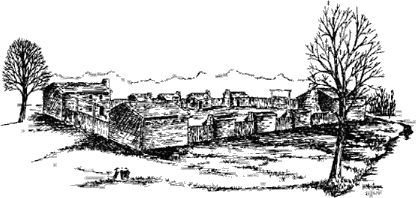
"It is an oblong square formed by houses making a double street, at the angles were stockaded bastions. The situation is romantic among wooded hills. A stream of fine water passes at the foot of the hills which turns a small grist mill. They had been frequently alarmed & harassed by the Indians. Captain Logan, the person commanding here had his arm broken by a buckshot in a skirmish with them. The people here were not exceedingly well disposed to us and we were accosted by the females especially in pretty coarse terms. But the Captain and his wife were very civil and tractable."

Hamiltion gives a good description of the area at this time, on his way from Logan's Fort to Col. William Whitley's.

"The difficulty of marching through such country as this is not readily imagined by a European. The Canes grow very close togather, to the height of 25 feet and from the thickness of a quill to that of one's waist. (misprint, must have meant to write wrist.) As they are very strong and supple the rider much be constantly on watch to guard his face from them as they fly back with great force. The leaves and young shoots are a fodder horses are exceedingly fond of and are eternally turning right & left to take a bit. The soil where they grow is rich and deep so you plod thro in a narrow track like a cowpath, while the musketoes are not idle."

October 13, 1779 - Virginia Land Commissions, William Fleming, Edmond Lyne and John Barber, open their office at Logan's Fort.

October 20, 1779 - Benjamin Logan, receives settlement and preemption from commissioners.

"Benj. Logan this day claimed a right to a settlement preemption to a Track of Land Known by the name of St. Asaph Lying on the Waters of Dicks River by raising Corn & settling the said Land in the year 1775 Satisfactory proof being made to the Court they are of the Opinion that the said Logan has a right to a settlement of 400 Acres including the said settlement & a preemption of 1000 0Acres Adjoining & that a Certificate issues for the same."

March 20, 1780 - On a return trip to Logan's Fort, Col. William Fleming writes about the previous winter in his journal. The winter of 1779 became known as "The hard winter" to the settlers.

"The effects of the severe winter was now sensibly felt, the earth for so long a time being covered with snow and the water entirely froze, the Cane almost all killed, the Hogs that were in the Country suffered greatly, being frozen to death, in their b--s, the deer likewise not being able to get either water or food, were found dead in great numbers, tirkies dropt dead off their roosts and even the Buffalos died starved to death, in vast increase of people, near three thousand that came into this County with the prodigious losses they had in their cattle and horses, on their
Journey, and the severity of the winter after they got here killing such numbers."

December 11, 1802 - General Benjamin Logan, of Shelby County, died Saturday evening, of a stroke of apoplexy.


Copyright © 2000 Logan's Fort
P.O. Box 1775, Stanford, KY 40484
Phone: 606-365-1216
Fax: 606-365-1775